
Sometimes the Weirdest Music Is the Most Rewarding
Every vinyl collector has those records.
The albums that visitors pull from the shelf and immediately ask:
“What on earth is this?”
For me, one of those discoveries in 2026 has been Angine de Poitrine, the anonymous Quebec-based duo whose blend of microtonal rock, progressive rhythms, absurdist imagery, and undeniable musicianship has turned them into one of the year's most unexpected underground success stories. Their rapid rise has been fueled by a viral KEXP performance and growing international recognition.
The name itself adds to the initial confusion. In French, Angine de Poitrine is not a playful phrase so much as a medical term: it translates directly to angina pectoris, or chest-related heart pain. That was exactly what appeared when I first tried to research the band, making the discovery feel less like looking up a musical act and more like accidentally searching a cardiology symptom. In hindsight, that strange first impression fits the band perfectly: unsettling, oddly clinical, and memorable before a single note is even played.
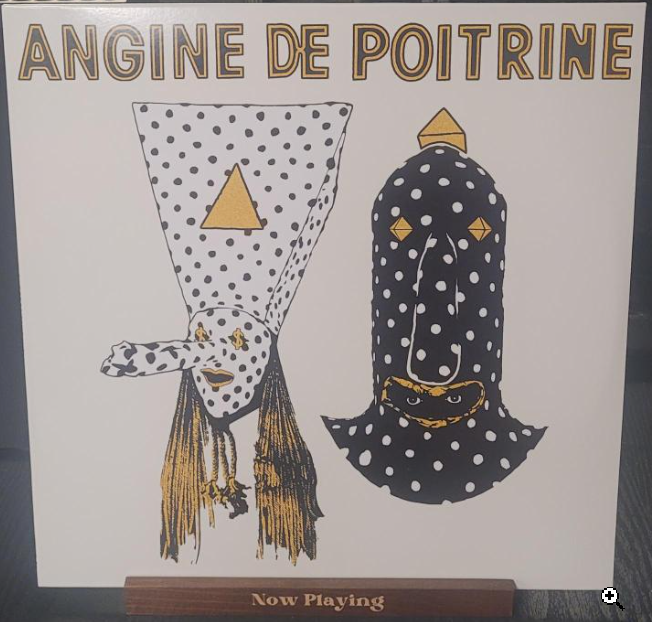
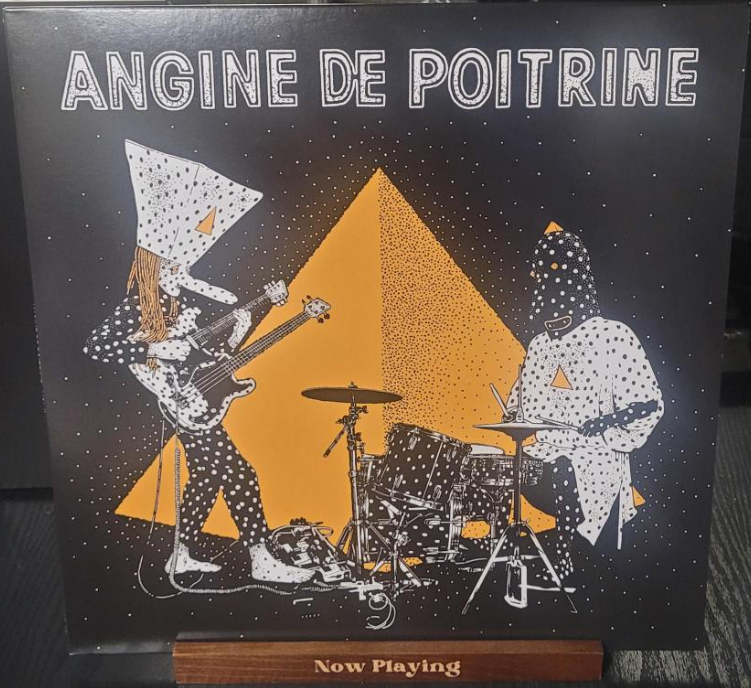
By the end of August, both Vol. I and Vol. II had found a permanent home in my vinyl collection, joining a shelf that ranges from classic rock and electronic music to jazz, hip-hop, and experimental recordings.
And yet, despite some very stiff competition, these may be the most unusual records I own.
First Impressions: This Makes No Sense
The first encounter with Angine de Poitrine can be bewildering.
The costumes.
The mythology.
The geometric artwork.
The references to hot dogs, pyramids, and mysterious narratives.
The complete refusal to behave like a conventional rock band.
Everything about the presentation suggests parody.
Then the music starts.
Suddenly it becomes obvious that beneath the absurdity is an astonishing level of technical ability.
What initially appears to be a joke quickly reveals itself as something much deeper: a carefully constructed musical project built around unusual tunings, hypnotic repetition, complex rhythmic structures, and remarkable precision. Critics have repeatedly highlighted that the music itself is not a gimmick, noting its difficult time signatures, microtonal melodies, and demanding live execution.
The rhythmic language is just as important as the tuning. Angine de Poitrine frequently leans into odd time signatures, abrupt metric shifts, and tightly looped patterns that feel closer to math rock and progressive rock than standard verse-chorus songwriting. The grooves can still be surprisingly danceable, but they often move in uneven groupings that keep the listener slightly off balance. That push and pull between repetition, precision, and rhythmic unpredictability is a major reason the music feels so strange without ever feeling random.
That contrast is part of the appeal.
The visual presentation makes you laugh.
The musicianship makes you listen.
The Microtonal Difference
One of the most fascinating aspects of Angine de Poitrine is their use of microtonal music.
Most Western music is built around the familiar twelve notes of the chromatic scale. Whether you're listening to The Beatles, Metallica, Miles Davis, or Daft Punk, that twelve-tone framework forms the foundation of what you hear.
Microtonal music explores the spaces between those notes.
That idea is not limited to experimental rock. Many world music traditions have long used pitch systems that move beyond the fixed twelve-note Western framework. Middle Eastern traditions often use intervals that sit between the notes of a piano, Indian classical performance relies on subtle pitch bends and ornamental micro-steps, and Indonesian ensembles use tuning systems that do not map cleanly to Western equal temperament. Those traditions remind us that microtones are not merely a modern novelty; they are part of a much wider global vocabulary for melody, tension, color, and expression.
The result can sound disorienting at first.
Melodies bend in unexpected directions.
Intervals feel unfamiliar.
Riffs seem simultaneously wrong and right.
Many listeners struggle to identify exactly what they're hearing because it doesn't align with the musical language most of us have absorbed over a lifetime of listening.
For Angine de Poitrine, those microtonal guitar lines have become a defining characteristic of their sound, creating a musical identity that feels both alien and strangely addictive. Music coverage surrounding the band's breakthrough repeatedly highlights their intricate microtonal guitar work and unconventional melodic structures.
Progressive Rock Without the Pretension
One of the surprises of these records is how accessible they remain despite their complexity.
There are obvious elements of:
- Progressive Rock
- Krautrock
- Experimental Music
- Psychedelic Rock
- Math Rock
- Electronic Music
- World Music influences
Yet the records never feel like academic exercises.
Instead, they groove.
The rhythms lock together.
The repetition becomes hypnotic.
The strange tuning systems become memorable melodies.
The technical complexity serves the music rather than overshadowing it.
That balance is rarer than many musicians realize.
The KEXP Effect
Like many listeners, my introduction to the band came through their now-famous KEXP session.
In an era when viral content often burns brightly and disappears quickly, Angine de Poitrine did something unusual.
They converted internet curiosity into genuine fandom.
Millions of viewers discovered the band through that single performance, and the momentum helped transform a relatively unknown act into a globally recognized underground phenomenon. Reports on the band's rise consistently point to their KEXP appearance as the catalyst for international attention.
The performance works because it demonstrates something that studio recordings alone cannot fully capture:
These musicians can actually play.
And play exceptionally well.
Why the Vinyl Matters
The global physical release of Vol. I and Vol. II on June 12, 2026 was an important milestone for the band and their fans. The albums became available worldwide through a network of distribution partners while maintaining the group's independent identity.
For collectors, that matters.
Streaming allows discovery.
Vinyl allows commitment.
Adding these records to a collection means they become part of your listening rotation rather than another forgotten recommendation buried inside a streaming algorithm.
There's also something fitting about experiencing music this unconventional on a physical format.
The artwork, presentation, and ritual of putting a record on the turntable complement the experience in ways that a playlist never quite can.
Final Thoughts
Music should occasionally surprise us.
It should challenge expectations.
It should make us question what is possible within familiar genres.
Angine de Poitrine accomplishes all three.
They're absurd.
They're unconventional.
They're occasionally baffling.
Yet they are also among the most musically intriguing discoveries I've made in recent years.
In a world increasingly optimized for predictability and algorithms, Angine de Poitrine feels refreshingly unpredictable.
And sometimes that's exactly what music needs to be.
The Albums in My Collection