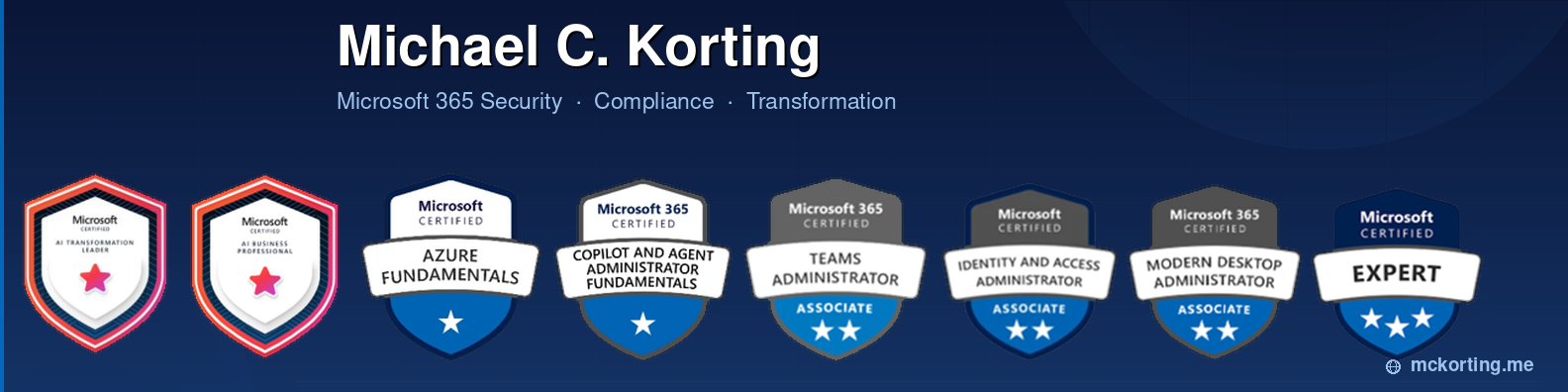

At a Glance
While reviewing my Microsoft Learn transcript recently, I realized the certifications tell only part of the story. What emerged was a clear timeline showing how Microsoft’s technology priorities evolved over the past several years and how my own career evolved alongside them.
The pattern is clear: my own learning path has followed Microsoft’s broader shift from productivity and administration toward Zero Trust, governance, cloud security, and AI-powered business transformation.
View My Microsoft Learn Transcript
Modules Completed
Learning Paths
Exams Passed
Active Certifications
Applied Skills
Training Completed
What began as focused Teams administration training grew into a broader Microsoft Learn journey across collaboration, identity, security, compliance, endpoint management, Power Platform, Azure, and now AI transformation. Looking back, this was not a random collection of badges or exams. It was a progression. Each phase built on the last, and each section of the transcript reflects the technologies customers were asking about, the risks organizations were trying to manage, and the areas where Microsoft’s cloud platform was rapidly changing.
The most useful part of reviewing the transcript is not simply seeing the number of modules, learning paths, certifications, and applied skills. The more interesting story is the timeline. Over the past nearly five years, the focus moved from collaboration and productivity into governance, security, endpoint management, data protection, Azure foundations, Copilot readiness, and ultimately AI transformation.
Timeline: A Nearly Five-Year Microsoft Learn Arc
My Microsoft Learn journey started with practical collaboration and automation topics: Microsoft Teams, SharePoint Online, Dataverse for Teams, Power Apps, Power Automate, workflow automation, and low-code application development.
The focus sharpened around Teams governance, Teams Phone, meetings and calling, Teams Rooms, devices, external collaboration, security controls, and identity. This phase led to MS-700 in January 2024 and SC-300 in April 2024.
Copilot readiness appeared early in the journey, including implementation, data protection, compliance, tenant health, and administrative roles. That foundation aligned directly with the MS-102 path and the Microsoft 365 Administrator Expert credential earned in August 2024.
The path then broadened into endpoint management with Intune, Windows Autopilot, Defender for Endpoint, device compliance, application management, Windows 365, and Azure Virtual Desktop. This phase led to the MD-102 Endpoint Administrator Associate certification in November 2024.
The learning shifted deeper into Microsoft Sentinel, Defender XDR, Security Copilot, threat intelligence, incident response, KQL, Purview, DLP, retention, eDiscovery, insider risk, and communication compliance. This was the section where security and data governance moved from supporting concepts to core design considerations.
Before moving deeper into AI certifications, I completed the Azure Fundamentals learning path and earned Microsoft Certified: Azure Fundamentals by passing AZ-900 in January 2026. While often viewed as an entry-level cloud certification, AZ-900 filled an important gap in my learning journey by providing broader exposure to Azure architecture, governance, cost management, networking, identity, storage, and cloud operating models. That foundation became increasingly relevant as the learning path shifted toward Copilot, Azure AI services, Azure AI Foundry, cloud governance, and enterprise transformation initiatives.
Certification Milestone Snapshot
| Year | Milestone | Theme |
|---|---|---|
| 2024 | MS-700 | Teams administration, collaboration governance, meetings, calling, and Teams Phone |
| 2024 | SC-300 | Identity, Conditional Access, MFA, privileged access, and access governance |
| 2024 | MS-102 | Microsoft 365 administration, security, compliance, Exchange, Defender, Purview, and tenant health |
| 2024 | MD-102 | Endpoint management, Intune, device compliance, Windows Autopilot, and Defender for Endpoint |
| 2025 | Applied Skills | Copilot readiness, information protection, DLP, retention, eDiscovery, and communication compliance |
| 2026 | AZ-900 | Azure architecture, cloud concepts, governance, identity, storage, networking, and cloud economics |
| 2026 | AB-900 | Copilot and Agent Administration fundamentals |
| 2026 | AB-730 | AI business value, adoption, use cases, readiness, and organizational transformation |
| 2026 | AB-731 | AI transformation leadership, strategy, responsible AI, governance, and change management |
Callout: The Path Was a Progression, Not a Pivot
The move from Teams Administrator to AI Transformation Leader was not a leap. It was a progression. Teams administration required governance. Governance required identity. Identity required security. Security required compliance. Compliance required data protection. Data protection became essential for Copilot readiness. Copilot readiness now feeds directly into AI transformation.
The Foundation: Teams, Power Platform, and Collaboration
My Microsoft Learn journey started in 2022 with practical collaboration and automation topics. The early focus was Microsoft Teams, SharePoint Online, Dataverse for Teams, Power Apps, Power Automate, workflow automation, and low-code application development.
That early work was about helping organizations collaborate better, automate business processes, and govern Microsoft 365 more effectively. At the time, it may have looked like a productivity-focused learning path, but in hindsight it established an important foundation: understanding how people actually work inside Microsoft 365.
Teams Administration and Identity Security
By 2024, the focus sharpened around Microsoft Teams administration. Governance, Teams Phone, meetings and calling, Teams Rooms, devices, external collaboration, and security controls became the center of the learning path.
That effort led to passing MS-700 and earning the Microsoft Teams Administrator Associate certification in January 2024. From there, the path expanded into identity and access management through Entra ID, Conditional Access, MFA, Privileged Identity Management, Identity Governance, external identities, and role-based access. This work resulted in passing SC-300 in April 2024.
Callout: Identity Became the Control Plane
As the learning path moved from collaboration into administration and security, identity became the connective tissue. Conditional Access, MFA, privileged access, access reviews, external identities, and role governance are not isolated features. They are the foundation for secure Microsoft 365 operations.
Copilot Readiness and Microsoft 365 Administrator Expert
One of the more interesting parts of the transcript is how early Copilot appears. In spring 2024, I was already completing learning around Microsoft 365 Copilot readiness, implementation, data protection, compliance, tenant health, and administrative roles.
That timing matters because Copilot success depends on the same fundamentals that surfaced throughout the transcript: identity, permissions, data governance, security, and compliance.
The next major milestone was the Microsoft 365 Administrator Expert path. Preparing for MS-102 required study across Exchange Online, Defender, Purview, Entra ID, identity synchronization, Secure Score, compliance, threat protection, and information protection. I earned the credential in August 2024.
Endpoint Management, Security Operations, and Purview
After tenant administration, my learning broadened into endpoint management with Intune, Windows Autopilot, Defender for Endpoint, device compliance, application management, Windows 365, and Azure Virtual Desktop. This led to the Microsoft Endpoint Administrator Associate certification in November 2024.
In 2025, the learning shifted deeper into security operations and data protection: Microsoft Sentinel, Defender XDR, Security Copilot, threat intelligence, incident response, KQL, Purview, DLP, retention, eDiscovery, insider risk, and communication compliance.
That work resulted in three Applied Skills credentials focused on Copilot readiness, information protection, DLP, retention, eDiscovery, and communication compliance.
Callout: Security Became Central
Identity, Zero Trust, Defender, Purview, compliance, and governance moved from supporting topics to core requirements for modern Microsoft cloud environments. That pattern is clear across the transcript, and it matches what customers increasingly need from Microsoft 365 consulting work.
Azure Fundamentals: Expanding Beyond Microsoft 365
While much of my learning journey focused on Microsoft 365, identity, security, endpoint management, and compliance, another important milestone came with Azure Fundamentals. In January 2026, I earned the AZ-900 certification after completing learning focused on cloud concepts, Azure architecture, governance, identity, networking, storage, and cost management.
For many Microsoft professionals, Azure Fundamentals serves as an introduction to cloud computing. For me, it represented something slightly different. It helped connect years of Microsoft 365 administration experience to the broader Microsoft cloud ecosystem. Concepts such as identity, governance, compliance, security, and workload management were familiar, but now viewed through a wider Azure lens.
That knowledge became increasingly important as conversations shifted toward Azure AI services, Azure AI Foundry, cloud-based data platforms, and enterprise AI initiatives. Understanding the underlying cloud platform created a stronger bridge between traditional Microsoft 365 administration and the next generation of AI-enabled business solutions.
Callout: Azure Became the Bridge to AI
AZ-900 was not just another fundamentals credential. It connected the Microsoft 365, security, identity, data, and governance work to the broader cloud platform that supports modern AI solutions. For customers, that bridge matters because AI transformation often depends on cloud architecture, data placement, identity design, governance, and cost awareness.
AI, Copilot, and Business Transformation
The most recent phase shows the natural continuation of that foundation: Azure, AI, Copilot, agents, Azure AI Foundry, responsible AI, governance, and business transformation.
This is where the journey moved from administering Microsoft 365 services to helping organizations understand how AI can create business value when built on secure, governed, and well-managed cloud foundations.
Recent certifications and credentials include AB-900 Copilot and Agent Administration Fundamentals, AB-730 AI Business Professional, and AB-731 AI Transformation Leader.
The important lesson is that AI adoption does not begin with a prompt library, a demo, or a license assignment. It begins with readiness. Organizations need to understand where their data lives, who has access to it, whether their permissions model has grown out of control, how sensitive information is classified, and whether their users understand the difference between experimentation and governed business use.
That is why Copilot readiness, governance, security, and adoption strategy are now inseparable. A successful AI program requires more than enthusiasm. It requires clean information architecture, mature identity controls, endpoint trust, data protection, change management, and a realistic understanding of where AI can improve daily work.
Agent-based workflows make that even more important. As organizations move from individual Copilot assistance into repeatable AI-powered processes, the design questions become more operational: what data should the agent use, what actions should it be allowed to take, how should outputs be reviewed, and how does the organization measure value without creating new risk?
Callout: AI Builds on Strong Foundations
AI is not separate from Microsoft 365 administration, security, compliance, or endpoint management. It depends on all of them. The organizations that will get the most from Copilot and AI are the organizations that understand their identities, permissions, data, devices, governance model, and adoption strategy.
What the Journey Shows
Looking across the transcript, three themes stand out.
First, technology never stops moving. The path began with Teams and Power Platform, then expanded into identity, endpoint management, security operations, Azure fundamentals, information protection, and AI.
Second, security became central. Identity, Zero Trust, Defender, Purview, compliance, and governance moved from supporting topics to core requirements for modern Microsoft cloud environments.
Third, AI builds on strong foundations. The move from Teams Administrator to AI Transformation Leader was not a leap. It was a progression. Each certification and learning path built on the previous one.
Looking Forward
As I begin my next chapter as a Senior Microsoft 365 Consultant at Sycomp, I see this transcript as more than a list of certifications. It represents a commitment to continuous learning, hands-on practice, and helping customers adopt Microsoft technologies securely and effectively.
The learning journey continues. Microsoft’s cloud platform is evolving quickly, and the skills that mattered three years ago are no longer enough on their own. Today’s consultants need to understand security, governance, compliance, automation, data protection, Azure foundations, adoption, and AI as a connected ecosystem.
The goal remains the same: help organizations securely adopt modern technology, realize business value, and prepare for the next generation of Microsoft cloud and AI solutions. That challenge is exactly what makes this profession exciting.
Microsoft Learn Journey at a Glance
- 277 Modules Completed
- 70 Learning Paths Completed
- 9 Certification Exams Passed
- 9 Active Certifications
- 3 Applied Skills Credentials
- 194 Training Hours Completed
Current Certifications
- Microsoft 365 Administrator Expert
- Microsoft Teams Administrator Associate
- Microsoft Identity and Access Administrator Associate
- Microsoft Endpoint Administrator Associate
- Azure Fundamentals
- Copilot and Agent Administration Fundamentals
- AI Business Professional
- AI Transformation Leader
- Dynamics 365 Fundamentals (CRM)