
As I continue studying for the SC-100: Microsoft Cybersecurity Architect certification, I've started noticing something interesting about the case studies contained in Microsoft's learning materials.
Initially, I approached each case study as a separate problem. One organization needed stronger identity controls. Another needed secure application development and cloud-native protection. A third focused on manufacturing environments, IoT devices, and infrastructure security. The fourth centered on identity governance and data protection.
At first glance, these appear to be completely different security challenges requiring completely different solutions. However, after reviewing the final architecture diagrams from each case study side by side, a pattern became impossible to ignore.
The organizations were different. The business requirements were different. The workloads were different. Yet Microsoft repeatedly arrived at nearly the same architectural destination.
Cybersecurity Architects Think Differently
One of the biggest shifts when studying SC-100 is moving away from an administrator mindset.
Administrators often focus on individual technologies:
- How do I configure Conditional Access?
- How do I deploy Azure Arc?
- How do I enable Defender for Cloud?
- How do I onboard a server?
- How do I create a Sentinel workbook?
Architects ask a completely different question:
That distinction appears throughout every SC-100 case study. The diagrams are not product deployment guides. They are demonstrations of Microsoft's cybersecurity architecture principles.
Four Different Scenarios
The SC-100 case studies focused on four categories of security challenges:
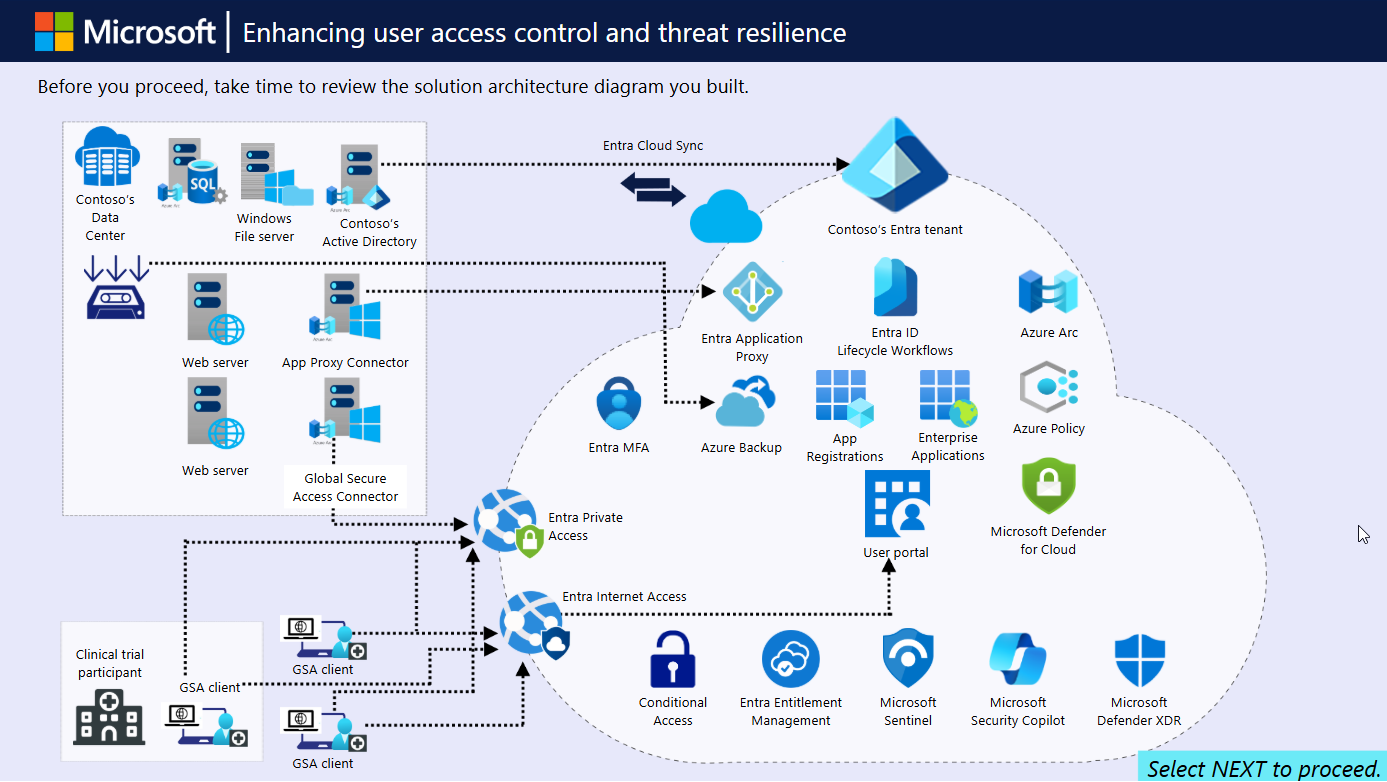
Enhancing User Access Control and Threat Resilience
This solution emphasized:
- Microsoft Entra ID, MFA, and Conditional Access
- Entra Private Access and Entra Internet Access
- Entitlement Management and Lifecycle Workflows
- Microsoft Sentinel, Defender XDR, and Security Copilot
Objective: Modernize access control and reduce identity-related risk.
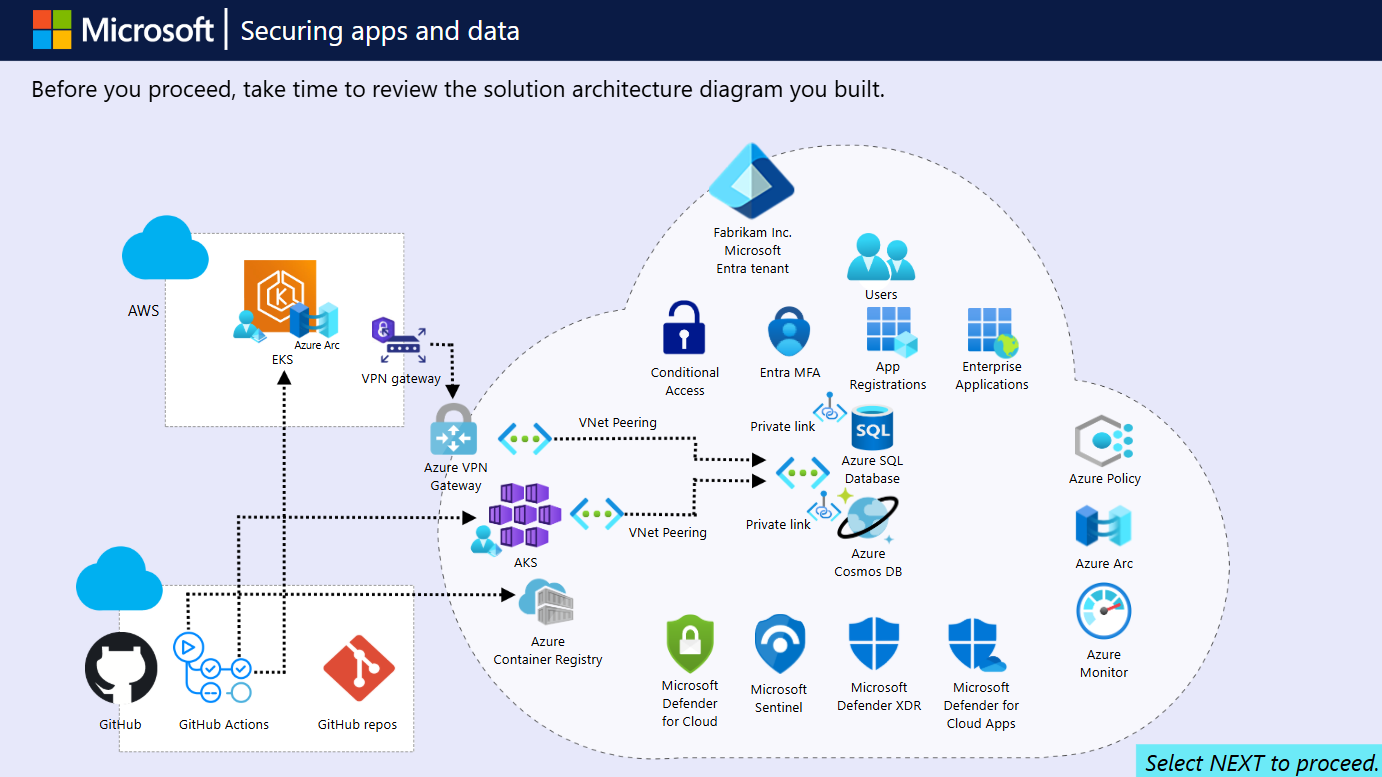
Securing Applications and Data
This architecture focused on:
- GitHub and GitHub Actions
- Azure Kubernetes Service and Azure Container Registry
- Azure SQL Database and Azure Cosmos DB
- Private Link, Defender for Cloud, and Azure Arc
Objective: Protect cloud-native workloads and secure the software development lifecycle.
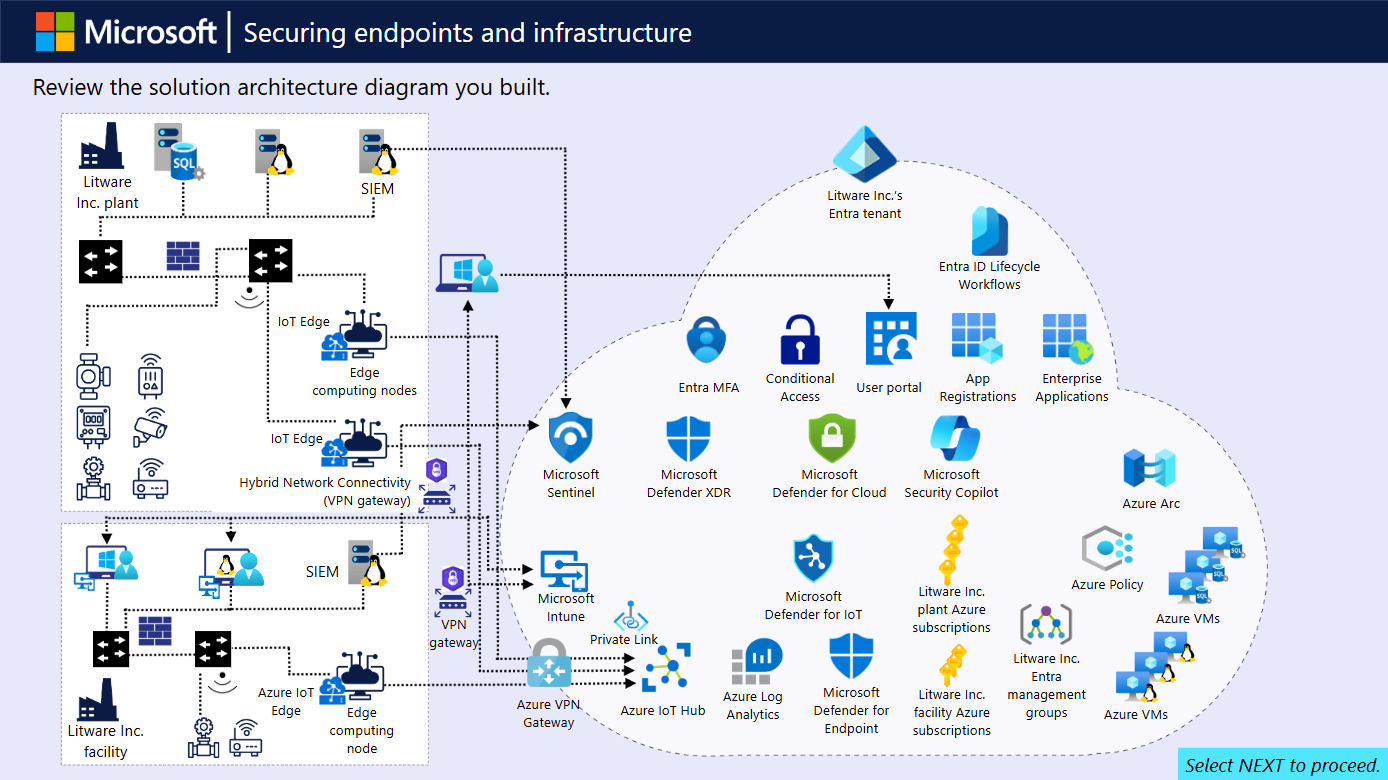
Securing Endpoints and Infrastructure
This case study introduced:
- Manufacturing facilities and IoT devices
- Azure IoT Hub and Azure IoT Edge
- Defender for IoT, Defender XDR, and Sentinel
- Azure Arc and Microsoft Intune
Objective: Unify security across operational technology, endpoint devices, and infrastructure.
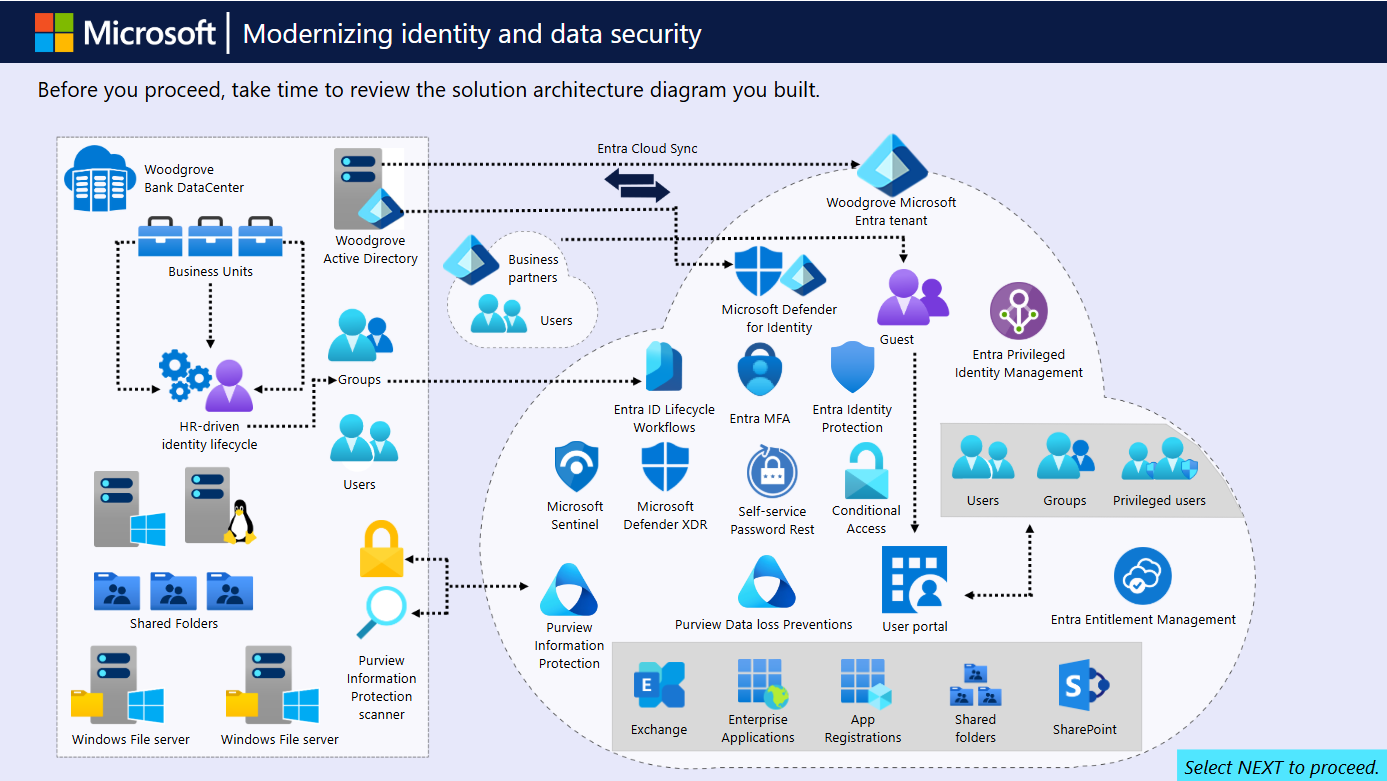
Modernizing Identity and Data Security
This architecture focused heavily on:
- Identity governance and Privileged Identity Management
- Lifecycle Workflows and guest access controls
- Microsoft Purview and Data Loss Prevention
- Defender for Identity and Entra Entitlement Management
Objective: Protect identities and sensitive information throughout the user lifecycle.
The Surprising Discovery
Although these architectures started with different business requirements, nearly every solution ultimately converged on the same foundational services.
Identity Layer
Every architecture relied on Microsoft Entra. Common controls included Entra ID, MFA, Conditional Access, Enterprise Applications, and App Registrations.
Identity was consistently treated as the primary security boundary. That is a core Zero Trust principle. Rather than trusting the network, trust decisions are continuously evaluated based on identity, device state, risk signals, and access requirements.
Governance Layer
Azure Arc and Azure Policy appeared repeatedly across multiple architectures. That observation was particularly interesting to me because Azure Arc was also the technology that initially introduced me to the broader Microsoft security ecosystem.
Azure Arc allows organizations to extend Azure governance controls to resources that exist on-premises, in branch offices, in AWS, in other cloud providers, and in edge locations.
As organizations become increasingly hybrid, governance becomes impossible without a centralized control plane. That is where Azure Arc frequently enters the architecture.
Security Operations Layer
Every architecture eventually fed security data into operational monitoring solutions. The recurring pattern included Microsoft Sentinel, Defender XDR, and Security Copilot.
Regardless of whether a threat originated from a user identity, server, application, container, IoT device, or database, the operational workflow remained remarkably consistent:
Security Is Becoming a Platform
One lesson repeatedly reinforced throughout the SC-100 material is that Microsoft is not positioning security as independent products. Microsoft is increasingly positioning security as an integrated platform.
- Entra provides identity signals.
- Conditional Access enforces decisions.
- Defender provides protection and telemetry.
- Sentinel correlates and analyzes events.
- Azure Policy governs configurations.
- Azure Arc extends governance to hybrid resources.
- Security Copilot assists analysts by consuming data from across the platform.
Security Copilot's Consistent Presence
One of the most interesting observations was seeing Microsoft Security Copilot appear throughout these architectures.
Security Copilot is not replacing security tools. Instead, it sits above them. As organizations generate increasing amounts of telemetry through Defender, Sentinel, Entra, and Azure resources, analysts face a growing challenge of understanding and acting on the data.
Microsoft's vision appears to be giving security teams AI-assisted analysis built directly on top of their existing security operations platform. That architectural direction was visible across multiple case studies.
The Hidden Architectural Blueprint
When I stepped back and looked at all four diagrams together, I realized Microsoft's cybersecurity architecture can almost be summarized as five connected layers.
Layer 1: Identity
- Entra ID
- MFA
- Conditional Access
- Identity Governance
Layer 2: Governance
- Azure Arc
- Azure Policy
- Compliance controls
Layer 3: Protection
- Defender XDR
- Defender for Cloud
- Defender for Identity
- Defender for Endpoint
- Defender for IoT
Layer 4: Operations
- Microsoft Sentinel
- Log Analytics
- Threat detection
- Incident response
Layer 5: Intelligence
- Security Copilot
- AI-assisted investigations
- Threat hunting
- Security insights
Regardless of the business problem being solved, nearly every architecture followed some variation of this blueprint.
What This Means for SC-100 Students
The biggest mistake someone can make when studying for SC-100 is trying to memorize products individually.
SC-100 is not about becoming an expert in every security tool. It is about understanding how identity, governance, protection, operations, and intelligence combine into a cohesive cybersecurity strategy.
The exam expects architects to connect solutions together rather than evaluate them independently. That is exactly what these case studies demonstrate.
My Biggest Takeaway
When I first started working with Azure Arc, I thought I was simply learning a hybrid server management technology.
As my experience expanded into Azure Policy, Defender for Cloud, Secure Score, regulatory compliance, Sentinel, Defender XDR, and now SC-100 preparation, I've realized these technologies are all pieces of the same puzzle.
The SC-100 case studies reinforce that realization. The architectures may begin with different business challenges, but they consistently converge on a common security platform built around Microsoft Entra, Azure Arc, Azure Policy, Defender, Sentinel, and Security Copilot.
For me, that has been the most valuable lesson of studying cybersecurity architecture so far.
These case studies provide one of the clearest examples of that philosophy in action.
References
- Study guide for Exam SC-100: Microsoft Cybersecurity Architect
- Microsoft Cybersecurity Reference Architectures (MCRA)
- Microsoft security best practices overview
- Learning Path: Design security solutions for applications and data
- Learning Path: Design security solutions for infrastructure
- Learning Path: Design security operations, identity, and compliance capabilities
SC-100 Case Study Solution Diagrams
The following four solution diagrams summarize the final architectures presented throughout the Microsoft SC-100 case studies.